

For most Australian riders, the best hands-free camera for motorcycle riding in 2026 is the POV Pro 4K UHD. It clips straight onto your jacket or chest and records in 4K without a helmet rig, which keeps you clear of the messy helmet laws that differ from state to state. Serious vloggers who want 8K and studio-grade footage should look at the Insta360 Ace Pro 2 instead.
Here is the thing nobody tells you before you spend seven hundred dollars on an action camera. The words “hands free” and “helmet camera” are not the same thing. One means you clip a device on and ride. The other means you build a mounting rig on your lid and, in a couple of Australian states, quietly risk a fine while you are at it. Most rider camera guides skip that part completely. This one does not. Below is an honest ranking, the pick that suits everyday riders, and the state-by-state legal situation that actually decides what you can put on your helmet.
Quick comparison
| Camera | Best for | Max Video | Lens | Battery | Hands-free (No Rig) | Approx AU Price |
|---|---|---|---|---|---|---|
| POV Pro 4K UHD | Everyday Riders | 4K/30 | 120° | ~180 min | Yes | $149 |
| Insta360 Ace Pro 2 | Motovloggers | 8K/30 | 157° | ~180 min | No | ~$689.99 |
| DJI Osmo Action 6 | Touring | 4K/120 | 155° | Long | No | ~$599 |
| GoPro Hero 13 Black | Mounting Range | 5.3K | Wide | Good | No | ~$649.95 |
| Insta360 X5 | 360 Creators | 8K 360 | 360° | Good | No | Premium |
| Sena 50C | Camera + Comms | 4K | 84° | Moderate | On Helmet | Premium |
The POV Pro is the only row with a clean “yes” on hands-free with no rig, at the lowest price. For the everyday rider, that column is the whole decision.
How we ranked them
Simple set of tests, weighted for real riding in Australia. Is it genuinely hands-free, or does it need a rig? How easy is it to mount and forget? What does it cost in Australian dollars? Battery for a normal ride, stabilisation for our rough regional roads,weatherproofing for a sudden downpour, and how much legal hassle it saves you. Here’s the Ranking.
1. POV Pro 4K UHD – best hands-free camera for everyday riders

This is the easiest clip and ride option going, and the one that keeps you out of the helmet law argument entirely. That is why it tops this list.
It shoots 4K at 30fps, with 2K and 1080p modes when you want longer recording time, through an ultra-wide 120-degree lens. You get AI stabilisation, voice control, a low light and night mode, and built-in Wi-Fi and Bluetooth for pulling footage onto your phone. The mounting is the clever bit for riders. Built-in magnets plus a back clip let it grab onto clothing, a jacket, a bag strap or a metal surface, so it goes on your body in two seconds flat. Battery runs to around 180 minutes, it fast charges in roughly 30 minutes, and it will record while charging if you wire it to the bike. MicroSD support goes up to 256GB.
For Australian buyers, it ships here with the price shown as tax inclusive and no surprise customs bill on delivery. It comes with a two-year limited warranty and a 30 day money back guarantee, so trying it is low risk.
Let me be straight about what it is not. It does not shoot 4K at 60fps, the 120-degree lens is narrower than the 150 degree plus view on the helmet cams, and it will not do dual-track audio through your Sena or Cardo headset. If your goal is a polished YouTube channel, this is not your camera. If your goal is easy, hands-free footage, insurance cover, and zero legal drama, nothing else here comes close on effort or price. Grab it from the POV Pro 4K UHD product page. (Insert the current AU price here from the product page before publishing.)
Best for: commuters and weekend riders who want reliable POV without a helmet rig.
2. Insta360 Ace Pro 2 – best image quality for motovloggers
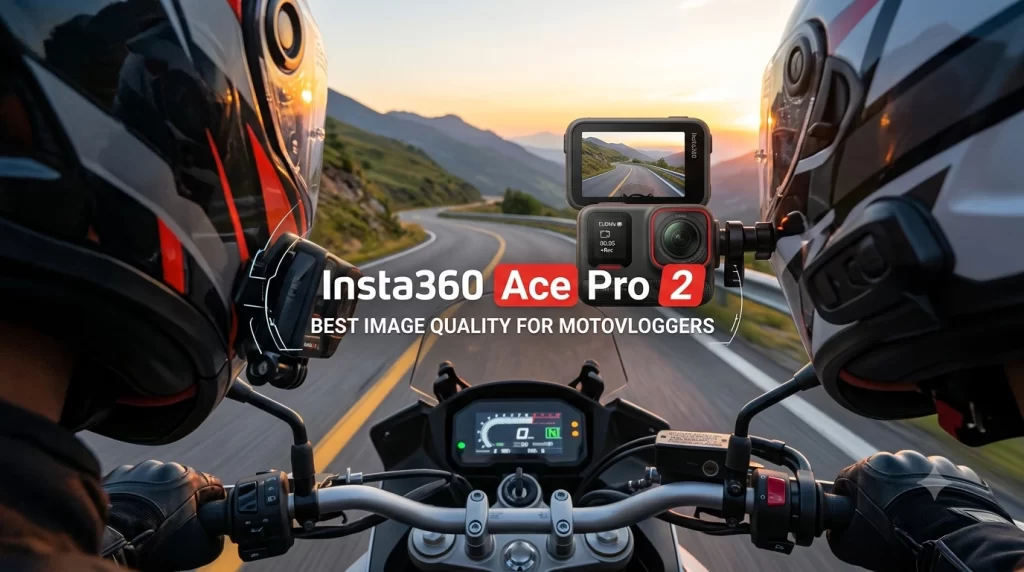
If footage quality is the whole point of the exercise, this is the class leader. It carries a 1/1.3 inch sensor co-engineered with Leica, shoots up to 8K at 30fps and 4K at 60fps with Active HDR, and it is genuinely strong in low light. Gesture and voice control work with gloves on and a full-face helmet on, which is a real thing for riders. It pairs with Sena and Cardo headsets for dual-track audio and has a proper dashcam mode.
Price sits at around AU$689.99. The catch is that 8K footage eats storage fast and needs a real editing setup behind it. Overkill for a commuter, but the right tool for a creator.
Best for: riders building a channel who want the best possible picture.
3. DJI Osmo Action 6 – best for long rides and touring
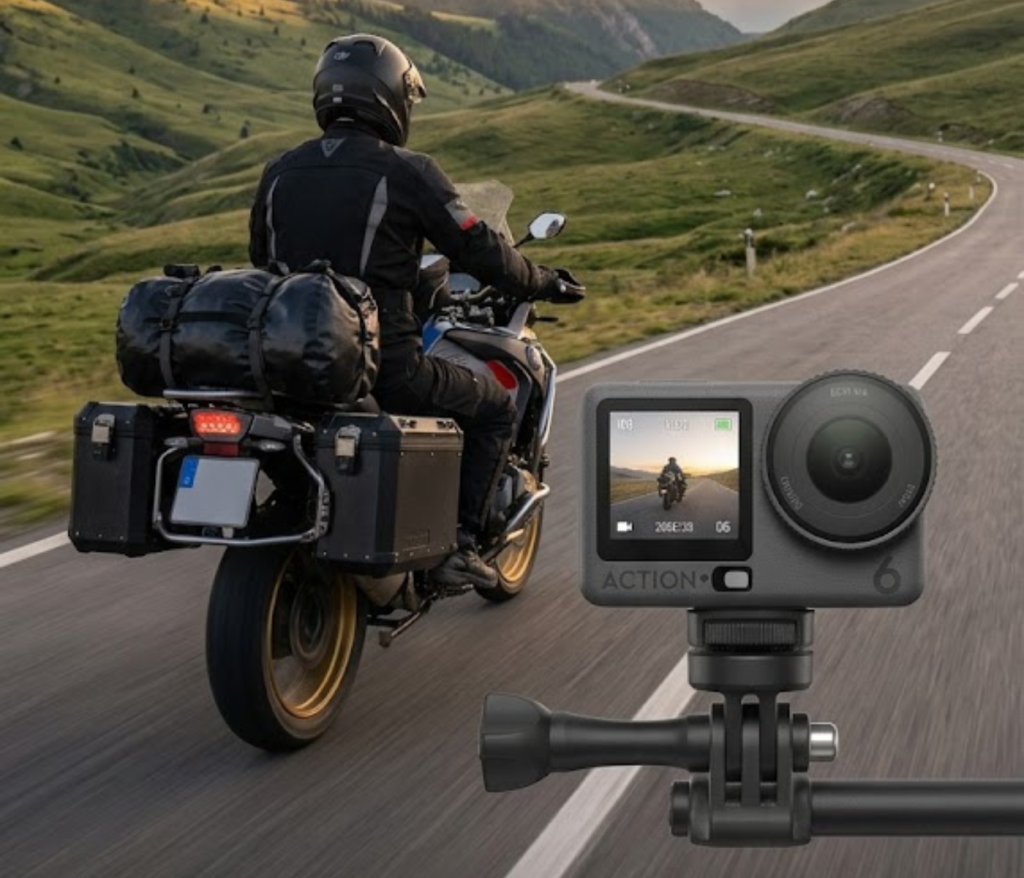
The endurance pick. DJI’s Osmo line is known for long 4K at 60fps recording and, on the Action 5 Pro, deeper waterproofing than either GoPro or Insta360. The magnetic mounting system is quick and works with standard mounts through an included adapter, and there is a solid dashcam loop mode with a GPS speed overlay through the app. The Osmo Action 5 Pro launched at around AU$599 and undercut its rivals on price, with the Action 6 now the current model.
Still a helmet or bike mount job, still premium money, but hard to fault for a long day in the saddle.
Best for: tourers and daily riders who want top quality and a long battery.
4. GoPro Hero 13 Black – best mounting ecosystem

The old benchmark, and still the most mature mount and accessory range out there. Its HyperSmooth stabilisation handles the high-frequency buzz of a motorcycle really well, and the standard bundle sits around AU$649.95. Worth being honest here, though. A growing number of tester roundups now knock GoPro for battery problems, freezing, and an app that frustrates, and a few leave it off their lists entirely. Take that as one strong opinion doing the rounds, not settled fact, and check recent reviews before you buy.
Best for: riders who want proven stabilisation and every mount under the sun.
5. Insta360 X5 – best for cinematic 360 footage

The creative wildcard. Because it captures everything around you in 360, you frame the shot after the ride, not during it. For an incident, that means you can show the moment from your point of view, from behind, and from above, all from one recording, which insurers and legal teams increasingly accept. It has a big sensor, strong low light, and a full set of motorcycle mounts.
The trade-off is real. Every single clip needs a reframing step in the app before you can watch it normally. It is powerful, but it is the least hands-free thing on this list.
Best for: creators who want reframing freedom and do not mind the editing.
6. Sena 50C – best if you want camera and comms in one
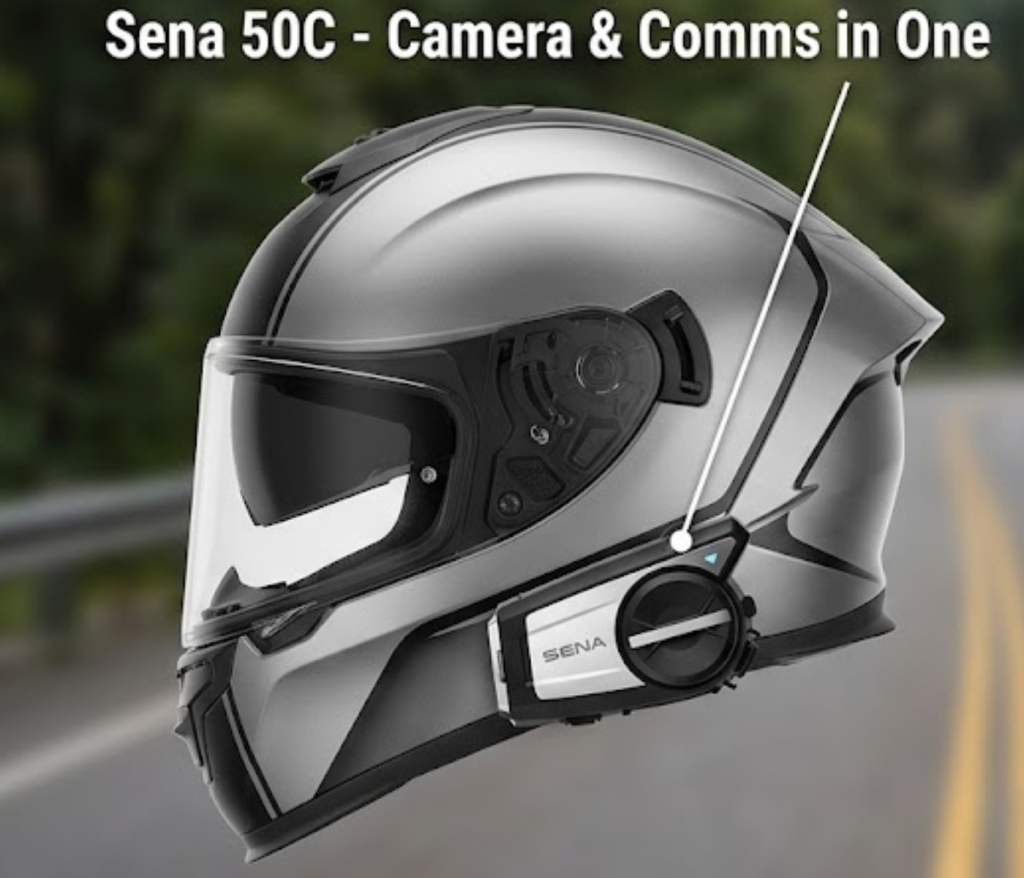
Worth a mention because it solves a specific annoyance. It is a camera and a motorcycle comms unit in one device, so you are not hanging a separate camera off your helmet. If you already run comms and want one less thing on your lid, it makes sense. But its stabilisation and low light lag well behind DJI, Insta360 and GoPro, and the app can be clunky.
Best for: riders who value comms and want the camera built into it.
What does “hands-free” really mean on a motorbike?
A hands-free camera is one you set once and forget. You clip it on, press record, and both your hands stay on the bars where they belong. That is the whole point.
Now look at how the big brands are usually mounted. A GoPro or an Insta360 goes on your helmet, either on the chin or up top. A chin mount gives the most natural rider eye view and the least wind resistance, which is why creators love it. But it is a rig. You are sticking hardware to a safety helmet, and that is where Australia gets complicated.
A wearable camera that sits on your chest or jacket dodges all of that. It is hands-free in the plain sense of the word, and it never touches your helmet. For a daily commuter who just wants footage in case some car merges into their lane, that difference matters more than another two stops of dynamic range.
Are helmet cameras even legal in Australia?
Short answer: it depends entirely on your state, and the rules are a mess. Queensland, South Australia and the ACT allow the use of helmet cameras. Cross a border and you can find yourself with an infringement notice for the exact same setup, because the law reads differently in other states.
The whole fight comes down to one question. Does sticking a camera on your helmet make an “approved” helmet suddenly “unapproved”? A motorbike helmet in Australia has to meet the AS/NZS 1698 standard, or an accepted equivalent. Some states’ road rules have been read to mean the helmet must stay compliant while you use it, which is where fines have come from. The better reading, argued strongly by road injury firm Maurice Blackburn, is that a helmet approved when it was made cannot be called non-compliant later just because a camera is attached. But that ambiguity is exactly why riders have copped fines they probably should not have.
There was meant to be a fix. The 2018 reform of the model Australian Road Rules clarified that helmet standards compliance is required at the point of manufacture only, and it removed the grey area around cameras and communication devices. The catch is that each state and territory has to actually legislate it, so adoption is uneven. The ACT, to its credit, has specific provisions allowing recording devices with frangible mountings, cameras included.
Victoria has its own strict rules on operating any device while riding. For portable, mounted, wearable and inbuilt devices, there are real limits on what you can touch and when, and learner and P plate riders face tighter restrictions again, per the TAC.
So what does a smart rider do? Clip a camera onto your body, switch it on before you set off, and never touch it again. That single habit keeps you on the right side of these rules no matter which state you are riding through. It is also, not by accident, exactly how a wearable POV camera is built to work. None of this is legal advice, and you should check your own state’s current rules before you ride, but the direction is pretty clear.
Different riders will weigh these differently, which is why each camera below has a clear “best for”. There is no single winner for everyone. There is a winner for you.
Where to mount it for true hands-free riding?
Body or chest clip is the real hands-free position. Nothing on the helmet, no legal question, footage from roughly your eye line. This is the sweet spot for the POV Pro.
If you do go the helmet route with one of the bigger cameras, a chin mount gives the most natural POV and the least wind drag, which suits higher speeds. A top mount gives that drone-like view over traffic but catches more wind as you speed up. Either way, turn on wind noise reduction in the app, and a small foam cover over the mic helps a lot on the motorway.
FAQ
1. Are helmet cameras legal for motorcycles in Australia?
It depends on the state. Queensland, South Australia and the ACT allow helmet camera use, while other states read their road rules differently and have issued fines. A body-worn camera that never touches your helmet sidesteps the whole issue. Always check your own state’s current rules.
2. What is the best hands-free camera for motorcycle riding?
For most riders, the POV Pro 4K UHD, because it clips onto your body and records in 4K without a helmet rig. Riders who want the best possible footage for content should choose the Insta360 Ace Pro 2 instead.
3. Do I need 4K, or is 1080p enough for a motorcycle camera?
For insurance and incident footage, 1080p is plenty to read number plates and show what happened. 4K helps if you plan to crop, zoom or post the footage. Most POV cameras, including the POV Pro, let you drop to 1080p to save storage and battery.
4. Can I use a motorcycle camera as a dashcam for insurance?
Yes. Many riders keep a camera running for exactly this reason, and multi-angle footage is increasingly accepted by insurers and legal teams after a crash. Loop recording, which several of these cameras offer, saves space by recording over old footage automatically.
5. Where should I mount a hands-free camera on a motorbike?
On your body, usually the chest or jacket, if you want true hands-free use with no helmet law worries. On the helmet chin, if you want the most natural rider eye view and you ride in a state that allows it.
6. How long should the battery last for a typical ride?
Around 90 to 180 minutes covers most commutes and day rides. The POV Pro runs for roughly 180 minutes and can record while charging, so you can wire it to the bike for longer trips.
Conclusion
If you ride to work, take the odd weekend run, and just want footage there when you need it, the POV Pro 4K UHD is the pick. Clip it on, ride, done, no rig and no legal headache. Spend the seven hundred dollars on the Insta360 or DJI only if filming is genuinely the point of your rides. Most people it is not, and that is completely fine.
Leave a Reply